
 English
 Indonesian
 简体字
简体字
 العربية
 Español
 Français
 Português
 日本語
日本語
 한국어
한국어
 Tiếng Việt
Sign In to Continue
To view and access the document, you are required to sign in to your account first.
Don't have an account? Sign Up Here
Home Stearic Acid Supply Chain: From Palm Oil Feedstock to Global Buyers
Supply Chain | 26 May 2026
Stearic Acid Supply Chain: From Palm Oil Feedstock to Global Buyers
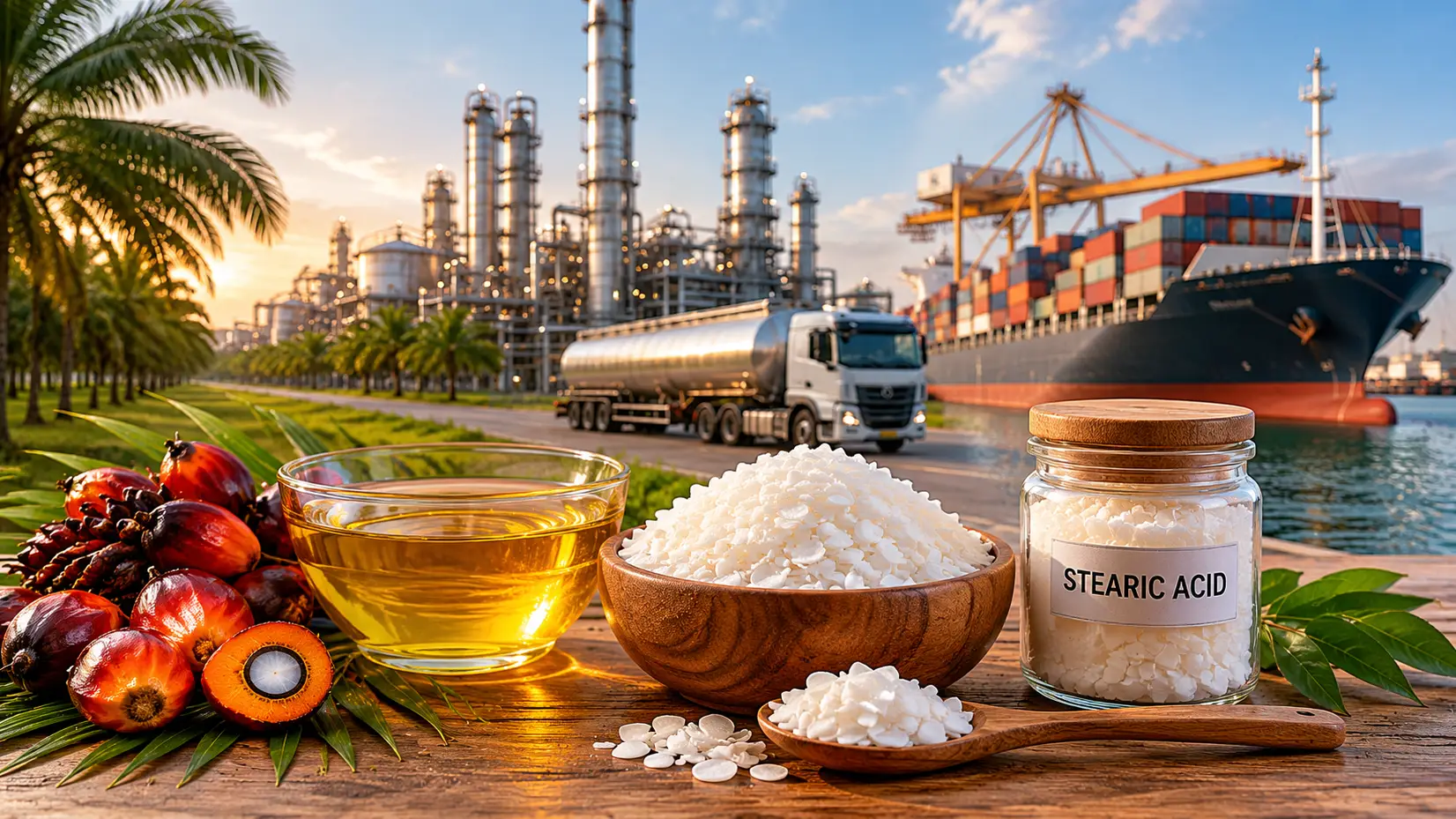
Table of Content
-
Introduction
-
Palm Oil Feedstock and Upstream Stearic Acid Sourcing
-
Industrial Production of Stearic Acid from Palm Oil
-
Product Features, Grades, and Applications of Stearic Acid
-
Global Stearic Acid Trade Flows and the Role of stearic-acid.net
-
Risk Management, Sustainability, and Future Market Trends
-
Conclusion
Introduction
The global market for stearic acid sits at the intersection of agriculture, oleochemical processing, and downstream manufacturing in sectors as diverse as personal care, plastics, rubber, candles, food, and pharmaceuticals. As an essential saturated fatty acid, stearic acid is valued for its thickening, stabilizing, lubricating, and surface-active properties. In recent years, palm-based stearic acid has become the dominant source, supported by large-scale palm oil plantations and integrated oleochemical complexes in Southeast Asia.
Understanding the stearic acid supply chain—from palm oil feedstock to finished product delivered to global buyers—is critical for procurement teams, formulators, and supply chain managers. Price volatility, sustainability expectations, and evolving regulations all influence how and where buyers source this key ingredient. Platforms such as stearic-acid.net, operated by Tradeasia, have emerged to connect producers and buyers, offering a structured approach to sourcing, documentation, and logistics.
This article provides a detailed, end-to-end view of the stearic acid value chain with a focus on palm-based feedstock. It covers upstream plantation dynamics, industrial production processes, product features and applications, international trade flows, and risk management. The goal is to equip decision-makers with practical market insights to support strategic sourcing and supplier selection in a fast-evolving oleochemical landscape.
Palm Oil Feedstock and Upstream Stearic Acid Sourcing
Most commercial stearic acid today is produced from vegetable oils, and palm oil has become the leading feedstock due to its high yield per hectare, year-round harvest, and well-developed processing infrastructure. Major producing countries such as Indonesia and Malaysia together account for more than 80% of global palm oil output, forming the backbone of the palm-based stearic acid supply. Crude palm oil (CPO) and palm kernel oil (PKO) are fractionated and refined, generating stearin and other fractions that serve as primary raw materials for stearic acid production.
Upstream, the supply chain begins with oil palm plantations, fresh fruit bunch (FFB) harvesting, and milling into CPO and PKO. Plantation productivity, weather patterns influenced by phenomena such as El Niño, and agronomic practices directly affect the availability and pricing of palm-based oleochemicals. Yield disruptions, labor shortages, or policy changes in producing countries can quickly ripple down to stearic acid prices. As a result, large buyers increasingly monitor plantation-level developments, sustainability certifications, and geopolitical risks as part of their risk management strategy.
Sustainability is now a central upstream concern. Brands and industrial users are under pressure to ensure that their palm-based stearic acid does not contribute to deforestation, peatland conversion, or social conflict. Certification schemes such as RSPO (Roundtable on Sustainable Palm Oil), ISCC (International Sustainability and Carbon Certification), and country-specific standards are increasingly requested in procurement specifications. Buyers working through specialized platforms like stearic-acid.net often seek traceability data, chain-of-custody documentation, and supplier audits to align stearic acid sourcing with corporate environmental, social, and governance (ESG) goals.
Industrial Production of Stearic Acid from Palm Oil
After refining and fractionation, palm-based feedstock enters integrated oleochemical plants, where it is converted into fatty acids, including stearic acid. The main industrial route is fat splitting followed by hydrogenation and distillation. In fat splitting, triglycerides from palm or palm kernel oil are hydrolyzed under high temperature and pressure in the presence of water, yielding a mixture of fatty acids and glycerin. This crude fatty acid mix typically contains a range of chain lengths (C12–C18 and beyond) that must be separated and refined.
Hydrogenation is used to saturate unsaturated fatty acids in the mixture, increasing the proportion of solid, high-melting components such as stearic acid (C18:0). Subsequent fractional distillation, often in multi-stage distillation columns under vacuum, isolates stearic acid at defined purity levels. Commercial grades commonly range from about 90% to 98% purity, with specific iodine values, acid values, and color specifications tailored for different industries. Some plants also produce double-pressed or triple-pressed stearic acid to achieve lighter color and lower impurity levels, which are preferred in cosmetics and pharmaceuticals.
Production technology and plant integration have significant implications for cost, quality consistency, and environmental performance. Modern facilities in Southeast Asia, China, and India often integrate glycerin refining, soap noodles production, and fatty alcohol lines, enabling economies of scale and flexible product slates. Energy efficiency measures, effluent treatment, and by-product valorization (for example, using distillation residues as fuel) are increasingly important as regulators and customers scrutinize the carbon footprint and environmental impact of oleochemical production. Buyers evaluating suppliers through channels such as stearic-acid.net frequently consider not only price and quality but also the technological maturity and environmental profile of production sites.
Product Features, Grades, and Applications of Stearic Acid
Stearic acid is a white to off-white waxy solid, usually supplied as flakes, beads, or pastilles. It has a typical melting point in the range of 68–72°C, depending on purity and composition, and is practically insoluble in water but soluble in many organic solvents and oils. Key quality parameters include acid value, saponification value, iodine value (indicating degree of saturation), color (often measured by Lovibond or Gardner scale), and heavy metal content for sensitive applications. Palm-based stearic acid is generally highly saturated, making it well-suited for applications requiring hardness, opacity, and stable structure.
Different industries require specific grades and certifications. In cosmetics and personal care, stearic acid is used as an emulsifying and thickening agent in creams, lotions, and sticks. Here, low-odor, low-color, and often RSPO-certified grades are preferred, and compliance with regulations such as EU Cosmetics Regulation and relevant ISO standards is important. In the rubber and tire industry, stearic acid acts as an activator and internal lubricant in vulcanization systems, improving dispersion of fillers like carbon black and enhancing processing. These users typically focus on consistent melting behavior, low ash content, and reliable bulk supply in bags or big bags.
Other major applications include PVC and plastic processing, where stearic acid functions as a lubricant and mold-release agent; candle manufacturing, where it improves hardness and burning characteristics; and food and pharmaceutical uses, where highly refined, food-grade or pharma-grade materials are required. Food-grade stearic acid must comply with standards such as FCC (Food Chemical Codex) or local food additive regulations, while pharma-grade material must meet pharmacopeial standards (e.g., USP, Ph. Eur.). Platforms like stearic-acid.net help buyers match required specifications—such as cosmetic-grade, rubber-grade, or food-grade—with appropriate producers, documentation, and packaging formats, ensuring that technical and regulatory needs are aligned with commercial terms.
Global Stearic Acid Trade Flows and the Role of stearic-acid.net
The global stearic acid market is closely linked to the geography of palm oil production and downstream manufacturing hubs. Southeast Asia, particularly Indonesia and Malaysia, is the largest export base for palm-based stearic acid and other fatty acids. Significant production capacity also exists in China, India, and parts of Europe, often integrated with local consumer goods and rubber industries. On the demand side, major importers include the United States, the European Union, East Asia (China, Japan, South Korea), and emerging markets in Africa and Latin America, reflecting the global distribution of consumer goods manufacturing.
Trade flows are shaped by freight rates, tariffs, sustainability requirements, and currency movements. For example, fluctuations in container shipping costs, especially during global disruptions, can materially affect delivered prices for stearic acid flakes in distant markets. Regulatory changes—such as the EU’s deforestation-related import requirements or country-specific anti-dumping measures—can alter sourcing patterns and supplier portfolios. Buyers increasingly seek diversified supply strategies, combining long-term contracts with spot purchases, and often work with international distributors who can manage inventory, documentation, and multimodal logistics.
stearic-acid.net, operated by Tradeasia, functions as a specialized digital interface between global buyers and qualified producers of stearic acid and related oleochemicals. Through this platform, buyers can access product specifications, safety data, packaging options, and indicative pricing, as well as submit structured inquiries. Tradeasia’s regional offices and logistics network support shipments from major production hubs to ports worldwide, offering options such as full-container-load (FCL) and less-than-container-load (LCL), along with tailored documentation for customs, quality assurance, and regulatory compliance. For procurement teams, this combination of online transparency and offline execution helps streamline supplier selection, reduce transaction costs, and ensure more predictable lead times.
Risk Management, Sustainability, and Future Market Trends
Managing risk in the stearic acid supply chain requires a holistic view that spans agricultural, industrial, and logistical stages. Feedstock price volatility is a key concern: palm oil prices can swing significantly due to weather events, policy shifts in biodiesel mandates, and speculative trading. These shifts directly influence stearic acid production costs. Buyers often respond by using hedging instruments where available, diversifying between palm-based and alternative sources (such as tallow-based stearic acid in some regions), and negotiating formula-based pricing that references public indices.
Supply disruptions and quality risks are also critical. Events like port congestion, pandemic-related lockdowns, or local regulatory changes can delay shipments or restrict export volumes. From a quality standpoint, inconsistent specifications, contamination, or non-compliance with local regulations can lead to batch rejections and costly reformulations. Working with established distributors and platforms such as stearic-acid.net can mitigate some of these risks by pre-qualifying suppliers, standardizing documentation, and providing local support for claims handling and product change notifications. Many buyers also implement supplier audits, dual sourcing strategies, and safety stock policies to enhance resilience.
Looking ahead, sustainability and innovation are reshaping the stearic acid landscape. Demand for certified sustainable palm-based products is expected to grow as consumer brands commit to deforestation-free supply chains and lower carbon footprints. At the same time, process innovations, such as more energy-efficient distillation, advanced wastewater treatment, and improved by-product utilization, are helping producers reduce environmental impact and comply with stricter regulations. There is also increasing interest in bio-based and circular alternatives, including stearic acid derived from other vegetable oils or waste-based feedstocks, though palm oil’s scale advantage remains significant. Buyers that actively track these trends and collaborate with partners like Tradeasia are better positioned to secure long-term, sustainable, and cost-effective stearic acid supply.
Conclusion
The journey of palm-based stearic acid from plantation to global buyer is a complex chain involving agricultural production, oleochemical processing, international logistics, and stringent quality and regulatory controls. Palm oil’s dominance as a feedstock, combined with large integrated production hubs in Southeast Asia and Asia-Pacific, underpins the global availability of stearic acid for applications ranging from cosmetics and rubber to plastics, candles, food, and pharmaceuticals. For procurement and technical teams, a clear understanding of each link in this chain is essential to balance cost, quality, sustainability, and supply security.
As markets evolve, buyers are placing greater emphasis on traceability, certified sustainable sourcing, and risk management tools that can withstand price volatility and logistical disruptions. Digital platforms such as stearic-acid.net provide structured access to multiple producers, standardized specifications, and coordinated logistics support, enabling global companies to streamline sourcing and maintain consistent supply. By combining these tools with robust internal procurement strategies and close collaboration with suppliers, organizations can optimize their stearic acid value chain and align it with broader ESG and innovation objectives.
This article is intended solely for informational and market insight purposes and does not constitute technical, safety, regulatory, or other professional advice. Readers should independently verify all information with qualified experts, consult official documentation such as MSDS/SDS and relevant standards, and, where appropriate, contact our team or other competent professionals before making decisions or using stearic acid in specific applications.
Tags
Most Popular Insights
Most Popular Insights
Don't miss out on our updates!
Subscribe to our newsletter now
We're committed to your privacy. Tradeasia uses the information you provide to us to contact you about our relevant content, products, and services. For more information, check out our privacy policy.