
 English
 Indonesian
 简体字
简体字
 العربية
 Español
 Français
 Português
 日本語
日本語
 한국어
한국어
 Tiếng Việt
Sign In to Continue
To view and access the document, you are required to sign in to your account first.
Don't have an account? Sign Up Here
Home Stearic Acid Documentation Checklist for International Trade
Regulatory and Compliance | 26 May 2026
Stearic Acid Documentation Checklist for International Trade
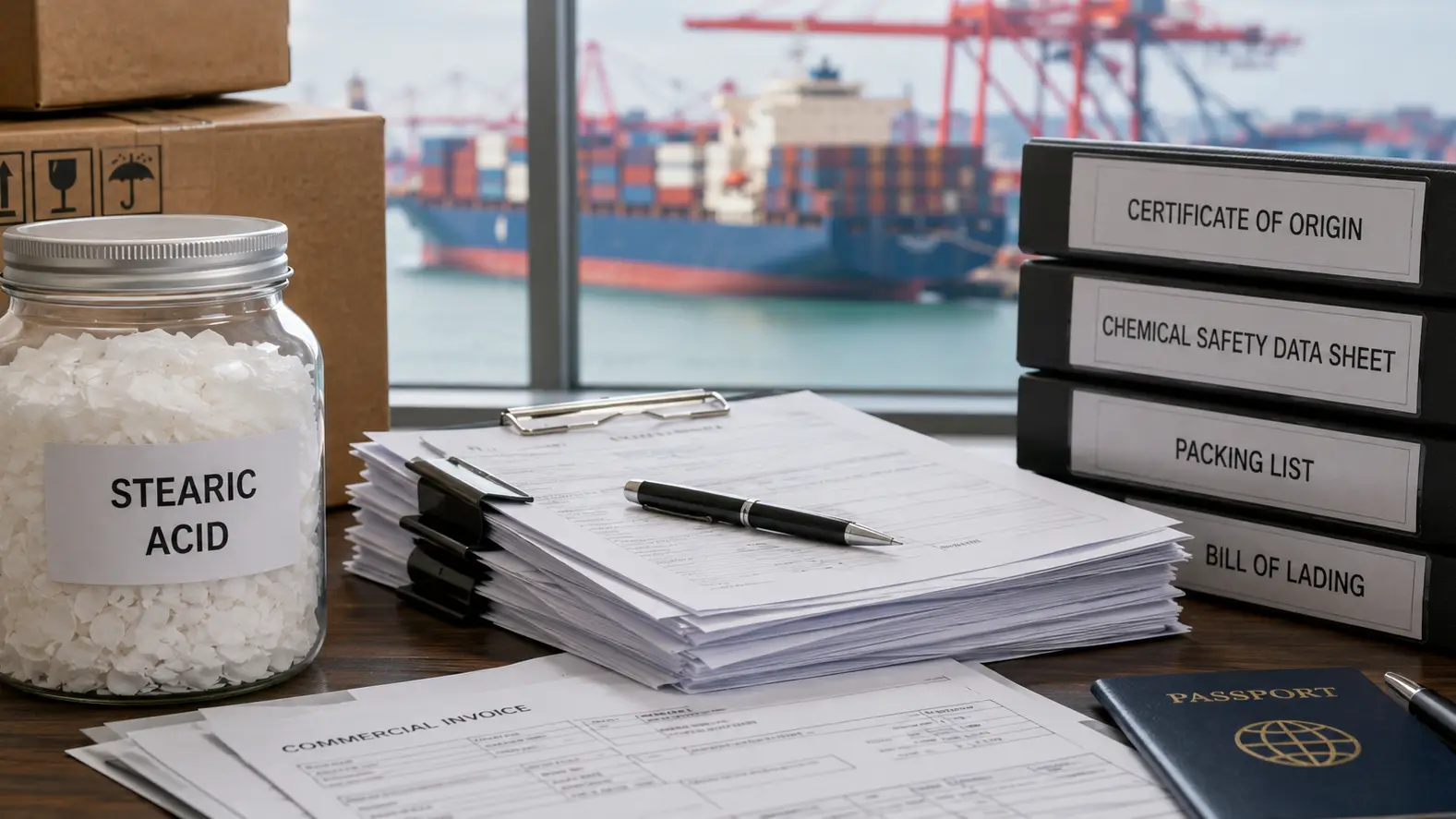
Table of Content
-
Introduction
-
Understanding Stearic Acid and Global Market Dynamics
-
Core Regulatory Frameworks Affecting Stearic Acid Trade
-
Essential Stearic Acid Documentation Checklist for Exporters and Importers
-
Product Specifications, Quality Standards, and Benefits for Buyers
-
Conclusion
Introduction
Stearic acid is a fundamental building-block chemical used in applications ranging from candles and rubber processing to cosmetics, pharmaceuticals, and food additives. Because it is shipped in large volumes across borders, traders, distributors, and manufacturers must navigate a complex landscape of regulations, certifications, and product documentation. Missing or incomplete paperwork can lead to shipment delays, customs holds, or even product recalls, with serious financial and reputational consequences.
This article provides a structured, practical documentation checklist for international trade in stearic acid, with a global perspective. It highlights the key documents required by customs authorities, regulators, and downstream customers, and explains how platforms such as stearic-acid.net and global suppliers like Tradeasia can support compliant trade flows. While specific requirements differ by country, the core principles and document types described here are widely applicable across major markets.
By understanding which certificates, declarations, and technical files are typically expected for stearic acid shipments, companies can better prepare their export and import operations. This reduces the risk of non-compliance, supports consistent product quality, and helps build trust with end-users in industries that are increasingly focused on safety, traceability, and sustainability.
Understanding Stearic Acid and Global Market Dynamics
Stearic acid (C18H36O2) is a saturated long-chain fatty acid commonly derived from vegetable fats (such as palm and palm kernel oil) or animal fats (tallow). In industrial trade, it is typically supplied as white flakes, beads, or pastilles, with different grades tailored for rubber, PVC, cosmetics, food, and pharmaceutical applications. The HS code most frequently used globally for stearic acid is in the range of 3823 (industrial monocarboxylic fatty acids), although exact subheadings can vary by jurisdiction.
Global demand for stearic acid has been growing steadily, driven by personal care, plastics, and rubber industries in Asia-Pacific, as well as ongoing demand in Europe and North America. Industry reports estimate that the global stearic acid market size is in the multi-billion-dollar range, with Asia-Pacific accounting for a significant share of both production and consumption. Major producing countries include Indonesia, Malaysia, China, and India, while large importing regions include the EU, the United States, and emerging markets in Africa and Latin America.
These market dynamics have two direct implications for documentation. First, the diversity of origin and destination countries means that traders must be familiar with a wide range of regulatory regimes. Second, end-users increasingly request detailed information on origin, sustainability certifications (such as RSPO for palm derivatives), and compliance with chemical regulations like EU REACH. As a result, platforms like stearic-acid.net are increasingly used as centralized sources for product data, safety documentation, and regulatory information to support cross-border transactions.
Core Regulatory Frameworks Affecting Stearic Acid Trade
Although stearic acid is generally considered to have a favorable safety profile compared with many industrial chemicals, it is still subject to chemical control regulations, classification and labeling rules, and in some cases food or pharmaceutical standards. In the European Union, stearic acid and its relevant grades must comply with REACH (Registration, Evaluation, Authorisation and Restriction of Chemicals) and the CLP Regulation for classification, labeling, and packaging. A compliant Safety Data Sheet (SDS) aligned with REACH Annex II is typically mandatory for B2B supply.
In the United States, stearic acid falls under the scope of the Toxic Substances Control Act (TSCA) if used in industrial applications, and must be listed on the TSCA Inventory. OSHA’s Hazard Communication Standard governs SDS content and labeling for workplaces. For food-grade stearic acid, additional requirements arise from the U.S. Food and Drug Administration (FDA), which recognizes certain stearates as GRAS (Generally Recognized as Safe) when used within defined limits.
Other key frameworks include China’s MEE Order 12 (for new chemical registration), Korea’s K-REACH, and national GHS implementations that affect labeling and SDS formats. Many countries also enforce specific rules on hazardous materials transport based on the UN Model Regulations, even if stearic acid itself is often not classified as dangerous for transport. Understanding which of these frameworks apply to a particular grade and application is an essential first step before assembling the correct documentation package.
Essential Stearic Acid Documentation Checklist for Exporters and Importers
Regardless of origin or destination, most international stearic acid transactions rely on a core set of commercial and regulatory documents. At a minimum, exporters should prepare a commercial invoice (with clear product description, HS code, Incoterms, and pricing), a packing list, and a bill of lading or airway bill. These documents are fundamental for customs clearance and must be consistent in terms of product naming, quantities, and identification of the buyer and seller.
From a chemical compliance perspective, a current and region-appropriate Safety Data Sheet (SDS) is one of the most important documents. The SDS should reflect the actual supplier, trade name, composition, hazard classification, and recommended handling measures. Many buyers also require a Technical Data Sheet (TDS) or product specification sheet that lists key physical and chemical parameters such as acid value, iodine value, color (e.g., Lovibond or Hazen), moisture content, and typical particle size. Platforms like stearic-acid.net often provide downloadable SDS and TDS versions to support due diligence.
Additional documents may be required depending on the customer segment and destination country. These can include a Certificate of Analysis (CoA) for each batch, a Certificate of Origin (sometimes legalized by a chamber of commerce), and declarations related to contaminants (e.g., heavy metals, residual solvents), allergens, or animal origin. For food or pharmaceutical applications, suppliers may be asked for GMP statements, Halal or Kosher certificates, and confirmation that the product complies with relevant pharmacopeia monographs (e.g., USP/NF, Ph. Eur.) or food additive codes (such as E570 in the EU).
Product Specifications, Quality Standards, and Benefits for Buyers
Because stearic acid serves diverse industries, detailed product specifications are crucial for matching the right grade to the intended application. Typical commercial grades include triple-pressed stearic acid, rubber-grade stearic acid, cosmetic-grade stearic acid, and food or pharma-grade material. Key parameters often listed on a TDS or CoA are acid value (mg KOH/g), saponification value, iodine value (a measure of unsaturation), melting point (usually around 69–72 °C for high-purity grades), color, and content of C18 fatty acid. Buyers rely on these specifications to ensure consistent performance in formulations such as PVC stabilizers, rubber vulcanization systems, and surfactant blends.
Suppliers such as Tradeasia and resources like stearic-acid.net help consolidate this information by presenting standardized product data and typical specification ranges for different grades. For example, a high-purity cosmetic-grade stearic acid may specify a minimum of 98% C18 content, low iodine value, and very low color to ensure stability and appearance in creams and lotions. Rubber-grade material may prioritize specific melting behavior and compatibility with zinc oxide and other additives. By comparing these specifications, procurement teams can quickly identify which grade best fits their process and regulatory needs.
Beyond technical fit, buyers increasingly look for documentation that demonstrates broader benefits, such as sustainability and supply reliability. This may include RSPO certification for palm-based products, ISO 9001 and ISO 14001 certifications for the production site, and statements on traceability or responsible sourcing. When combined with a robust documentation package—SDS, TDS, CoA, and regulatory declarations—these elements help buyers reduce qualification time, minimize compliance risk, and maintain consistent product quality across multiple production sites around the world.
Conclusion
Stearic acid’s versatility and global reach make it a strategic raw material for many industries, but also expose traders and manufacturers to a wide range of regulatory and documentation requirements. A structured checklist that covers commercial documents, SDS and TDS, CoA, origin and compliance certificates, and application-specific declarations is essential for smooth cross-border shipments. Leveraging centralized resources such as stearic-acid.net and working with experienced suppliers can significantly reduce administrative burden and help ensure that each shipment meets the expectations of customs authorities and downstream customers.
As regulatory frameworks continue to evolve—whether through updates to REACH, new national chemical inventories, or tighter food and pharma regulations—companies trading stearic acid must regularly review and update their documentation. Investing in robust data management, supplier qualification, and internal compliance procedures is no longer optional; it is a prerequisite for maintaining market access and customer trust. Those who treat documentation as a strategic asset rather than a last-minute task are better positioned to respond quickly to audits, customer inquiries, and changes in regulatory expectations.
This article is intended for general informational and market insight purposes only and does not constitute technical, safety, legal, or other professional advice. Requirements can vary significantly by jurisdiction, product grade, and end use, and readers should independently verify all information with qualified experts, consult official documentation such as MSDS/SDS and applicable regulations, or contact our team for guidance on specific applications before making any operational or compliance decisions.
Tags
Most Popular Insights
Most Popular Insights
Don't miss out on our updates!
Subscribe to our newsletter now
We're committed to your privacy. Tradeasia uses the information you provide to us to contact you about our relevant content, products, and services. For more information, check out our privacy policy.